
Sonia G. Caballero: the artist who turns gold into a bridge between Spain, Japan, and the Emirates
…Her piece The Year of the Tolerance, inspired by the Ghaf tree, was officially presented to the Emirati Consulate in Barcelona, and other works of hers have reached international collectors.

There are artists who search for a style. And there are others who invent it.
Sonia G. Caballero belongs to the latter category. Born in Madrid, shaped between two worlds and refined over more than twenty years in Japan, her work now converses with Dubai as if it had always been destined for this region: luxury, precision, spirituality, and futurity coexisting within a single stroke of gold.
Her painting—merging oil, ancestral Japanese techniques, and precious metals such as 24-karat gold, platinum, and silver—has reached Japanese galleries, international collectors, and even the Government of the United Arab Emirates. Her piece The Year of the Tolerance, inspired by the Ghaf tree, was officially presented to the Emirati Consulate in Barcelona, consolidating a cultural bridge that today defines her career.
I meet her for this interview in a luminous studio filled with Japanese brushes, metallic textures, and handwritten notebooks. Her presence conveys calm; her work, power. Each piece seems to possess its own heartbeat.

You lived for more than two decades in Japan, and now your work engages with the Emirates. What unites such seemingly distant worlds in your artistic universe?
Japan and the Emirates may appear distant, but within my work they share a common language. From Japan, I inherited precision, reverence for time, and techniques that demand patience and mastery. I spent more than two decades learning processes that very few people practice today, and they have become the essence of my work. In the Emirates, I have found a place where this artisanal dedication coexists with a determined vision of the future and a profound appreciation for noble materials. Here, working with 24-karat gold, platinum, or minerals is not merely aesthetic—it is a shared language. My work is born precisely there: between the Japanese tradition that shaped me and the contemporary vision I find in this country. Each piece is unique, created with uncommon techniques and exceptional materials, conceived to retain value over time and to offer the collector something truly unrepeatable.
Your painting The Year of the Tolerance was presented to the Government of the Emirates. What did that moment mean to you, and how was the work conceived?
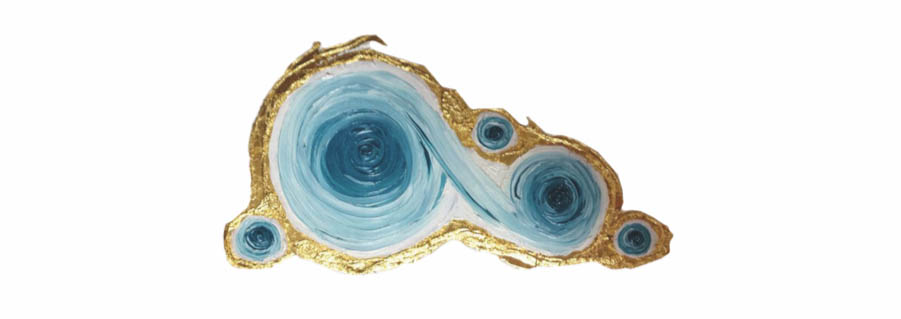
It was a commission from the Government of the Emirates itself, and from the very beginning I knew I had to honor not only the symbol of the Ghaf, but everything it represents for this land. The Ghaf was already part of the official logo of the Year of Tolerance, but my mission was to give it a soul—to translate its essence into my own language, forged between Japan, Spain, and the Emirates. I worked on the piece using traditional Japanese techniques—among them, inspirations from the Rinpa school—because they are methods that honor time, patience, and reverence for nature. The 24-karat gold that covers the piece symbolizes the desert sand; its fissures evoke the intensity of the heat that is part of Emirati life. Upon this golden base, blues and whites represent water—the most precious element, that which sustains life. And at the heart of the composition appear the blue spirals that run through many of my works. They are my symbolic signature: the gesture that unites the three worlds that have shaped my path—the Emirates, Japan, and Spain—into a continuous movement, as if the energy of each culture flowed seamlessly into the next. When the work was officially presented to the Government, I felt that something was closing and something new was opening at the same time.
It was more than institutional recognition: it was confirmation that my art can build real bridges between countries, sensibilities, and memories. For me, that piece is a tribute to tolerance, yes—but also to the miracle of what survives, what connects, what endures.
You work with gold and platinum as if they were colors. What draws you to these materials, and what role do they play in your visual language?
My relationship with gold and platinum was born in Kyoto. That journey completely changed the direction of my work. In Japan, I discovered something I had never seen anywhere else: the delicacy with which gold is integrated into art—not as a symbol of wealth, but as a gesture of respect, light, and silence. I understood then that gold is not a material; it is a way of seeing. From that moment on, I began working with gold and platinum. I do not apply them as metal, but as light. Gold allows me to build surfaces that vibrate, breathe, and transform space. Platinum, by contrast, brings a cool elegance, a subtle, almost lunar glow that opens a new dimension within my visual language. Today, I am the only artist in the world creating large-scale works using techniques inspired by the Rinpa school in platinum—a metal that is extremely difficult to work with, yet one that generates a unique, timeless presence. This has led to such platinum works already being held by Japanese collectors. The fusion of these metals with color creates a harmony that is essential to me. Gold and platinum do not merely add beauty; they bring durability, purity, and a character that turns each piece into a legacy designed to transcend generations. I am drawn to them because they are materials that do not disappear—they endure. And my work, at its core, seeks precisely that: to leave a luminous mark in time.

You have taken your painting into fashion, jewelry, and traditional Japanese techniques. Why did you decide that art should move beyond the canvas?
My art has never felt confined to the canvas. From an early age, I grew up surrounded by haute couture; my mother was a designer, and I learned to recognize beauty in every texture, every fold, every detail. That sensitivity taught me that art can live and breathe beyond a frame: in fabric, on the skin, in an object that accompanies daily life. During my training in Japan, I discovered ancestral techniques of painting on kimono, where each gesture, each stroke, is ceremonial and deeply connected to the person who wears it. That experience made me understand that painting can integrate into life, and that its value does not diminish when it leaves the canvas—it can, in fact, become something even more intimate and close. From there emerged my work on high-end pieces—Hermès, Chanel, Dior—where I apply gold, platinum, and my own techniques to transform bags and objects into unique works of art. It is not merely about luxury; it is about turning each piece into a legacy that combines tradition, mastery, and exclusivity. The same principle gives life to my jewelry pieces, Deseos Omamori, fruits of The Tree of Wishes: each jewel is a fragment of art, a wish made of gold and color, designed to accompany its owner and convey a message of connection, beauty, and eternity. For me, art that dares to step beyond the canvas reaches another dimension: it touches the lives of those who possess it, becomes something that is worn, felt, and passed on. It is an art that endures, uniting beauty, technique, and value in a tangible way.
You also run an art school for children. What inspired this educational dimension of your work?
…My approach to education was born from direct experience with children in Japan. I taught art at the Montessori school in Yokohama, creating my own projects, which I later compiled in a book titled 101 Creative Projects. Art, Culture, and Values. Each activity sought to awaken curiosity, imagination, and a connection with beauty from early childhood, showing that art is a tool to foster creativity, reflection, and problem-solving skills.
When Covid arrived and many children lost access to their art classes, several families asked me to do something to continue offering that experience. That was when I decided to create the online school, which today brings together more than 200 children, with exclusive courses and projects that apply Montessori methodology to art, adapted to each age and each student’s creativity. What motivates me is seeing how children discover that art not only allows them to express themselves, but also develops skills that will accompany them throughout life: critical thinking, problem-solving, confidence, and vision. It is fascinating to see how the creativity we cultivate in childhood becomes the capacity to face challenges in adult life.
Dubai is a central point on your creative map. What do you find here that you find nowhere else in the world?
Dubai is a place where light, space, and vision of the future come together in a unique way. Here, I feel that my work can breathe and expand, because this city understands the idea of the exceptional: beauty, perfection, and the values that accompany people over time. Dubai has the ability to unite tradition and modernity, luxury and culture, with a sensitivity for what builds legacy and human evolution. It is an environment where art is not only contemplated, but recognized as a tool of connection—where technique, gold, platinum, and creativity can dialogue with an audience that truly appreciates their value. Here, every project I undertake—whether paintings, bags, jewelry, or installations—becomes a bridge: between cultures, between ancestral techniques and contemporary vision, between East and West. Dubai offers me a space where my art can fully exist, accompany those who own it, and remain alive within their story.
You have series such as The Tree of Wishes that have deeply resonated with the public. What personal meaning does this symbol hold for you?
The Tree of Wishes is a very special work for me, because it was born from a moment of celebration and encounter between two countries. I created it for the exhibition at the Spanish Embassy in Tokyo, on the occasion of the 400th anniversary of Spanish-Japanese relations. This work combines Eastern and Western techniques, creating a visual language that unites sensitivity, detail, and ritual. Beyond aesthetics, the tree has a symbolic purpose: it invites people to dream, to connect with their wishes, and to believe in the possibility that they may come true. From that intention emerged the Deseos Omamori, “fruits” of The Tree of Wishes, conceived as talismans that accompany their owners and materialize a wish. Today, these works are present in 48 countries and serve as vehicles of hope. Recently, I presented the latest version, The Tree of Wishes – Summer, at CARE Expo Dubai 2025.
Your work connects Spain, Japan, and the Emirates. How do these three identities coexist within your creative process?
I would describe it as a continuous dialogue between technique, history, and vision. After living 23 years in Japan, its aesthetics, respect for discipline, and sensitivity toward nature are deeply rooted in the way I create; they emerge in every stroke, every texture, and in the light I seek to convey. Spain also lives within me profoundly: thanks to my grandfather, who often took me to the Prado Museum from a very young age, I absorbed the artistic history and the great masters who shaped our tradition. That early exposure taught me to love painting and to understand its emotional force—its ability to move and to remain in the memory of those who behold it. The Emirates provide a space where this fusion can fully unfold: here I find breadth, light, and an appreciation for the exceptional, allowing my works to become bonds that unite cultures, combining tradition, innovation, and noble materials to create unique pieces that resonate with those who contemplate and own them.
In the sector, it is known that you are developing a singular project: pieces and tiles made with gold.
Do you believe that major developers in the United Arab Emirates might be interested in integrating this proposal into their luxury, high-end projects? And if so, with which developer or developers would you like to collaborate?
Yes, it is a very special project that unites history, craftsmanship, and contemporaneity: ceramic tiles made with 18-karat gold, using Sevillian artisanal techniques dating back to 1800. These creations form part of my new works—The Gene of Youth, The Gene of Longevity, and The Gene of Fertility—conceived as activations of our divine intelligence, where every material, every texture, and every shimmer has a purpose: to inspire, connect, and accompany those who experience them. I believe this type of proposal can find a natural place within luxury and high-end projects in the Emirates, where art is integrated as an element of identity, exclusivity, and distinction. It would be a privilege to collaborate with developers who value the fusion of history, innovation, and excellence—companies that understand that each project can become an environment where art is not merely observed, but lived, transforming spaces. My aim is for these pieces not to be merely decorative, but true activators of experience, where architecture and craftsmanship meet creativity and luxury at their highest expression.
Finally: if you could paint a new wish for the coming years, what would it be?
To see my museum brought to life—a space where all facets of my work coexist: large-format painting, jewelry, applied pieces, and craftsmanship. There, visitors will be able to enjoy live concerts surrounded by the works, discover innovations such as instruments that incorporate art pieces, and encounter the work of emerging artists aligned with my vision. The museum will also include my Art School for children, where creativity and values are taught from early childhood, making art an experience that accompanies one throughout life. Today, this project already has a prelude: my atelier, which can be visited, allows one to feel up close the energy of the works that will later be exhibited. My wish is that those who walk through the atelier experience the fusion of cultures, techniques, and emotions—and that each visit awakens curiosity, inspiration, and the desire to become part of this unique project.
An artist who speaks three languages: matter, tradition, and the future
More than a painter who works with gold, Sonia Caballero is a creator who has woven an artistic identity capable of uniting three worlds. Her work breathes Japanese culture, Mediterranean emotion, and Emirati vision. In a global landscape where authenticity is sometimes lacking, Sonia affirms that beauty—when born with purpose—needs no explanation: it simply happens.
Read the original news article at: elcorreo.ae