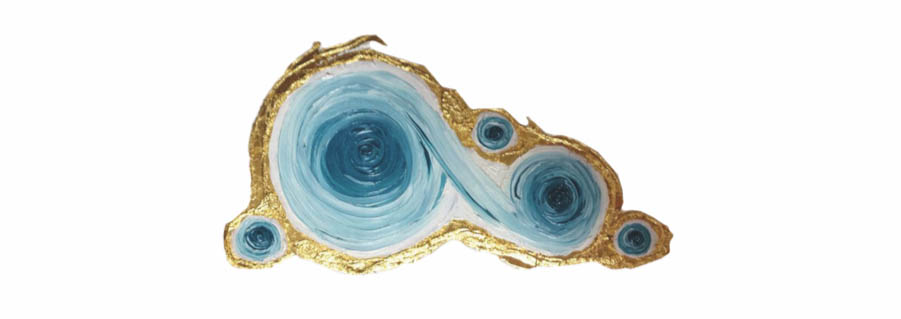

The Algorithm of Universal Beauty
Manifesto of Neonaturalism ©, Neuroaesthetics and the Fourth Phase of Water
Throughout history, art has been regarded primarily as a visual language, an emotional experience or an intellectual statement. Yet every decisive transformation in the history of art has occurred when artists have redefined the relationship between matter, knowledge and the way humanity understands reality. From the mathematical harmony of Classical Antiquity to the scientific curiosity of the Renaissance and the conceptual revolutions of the twentieth century, artistic creation has continually evolved alongside human thought. Today, we find ourselves at another of those pivotal moments, as scientific discovery and technological innovation are profoundly reshaping our understanding of perception, consciousness and the living world.
Fields such as artificial intelligence, neuroscience, biological research, and studies on human perception are expanding the intellectual landscape in which contemporary artists explore new questions about reality, consciousness and the human experience. These disciplines do not replace the role of art, nor do they diminish its poetic dimension. Instead, they provide new conceptual territories through which artistic practice may continue asking the timeless questions that have accompanied civilisation for centuries: What is beauty? How do we perceive reality? Why do certain forms move us more deeply than others? What invisible relationships exist between humanity, nature and the structures that govern life?
It is within this broader cultural context that Neonaturalism © was conceived. Rather than presenting art as a scientific demonstration, Neonaturalism proposes an artistic investigation into the possibility that beauty itself may possess an underlying structural logic rooted in the universal patterns repeatedly found throughout nature. My intention has never been to reduce artistic creation to scientific explanation. On the contrary, science serves here as a source of inspiration that allows artistic language to formulate new questions while preserving its symbolic, philosophical and emotional autonomy. Art remains art; however, it also becomes a place where different fields of knowledge may encounter one another freely, enriching our understanding of both.
This investigation begins from an artistic observation: nature reveals extraordinary systems of balance, efficiency and harmony that have inspired human creativity throughout history. Geometry, proportion, rhythm, symmetry and material behaviour are therefore not arbitrary decorative phenomena but recurring expressions of a deeper natural order. The artist’s role, in this sense, extends beyond the imitation of appearances. It involves recognising those universal principles and transforming them into a visual language capable of generating reflection, contemplation and intellectual dialogue.
Rather than understanding beauty as an entirely subjective experience, Neonaturalism explores whether certain visual structures possess an exceptional ability to establish meaningful relationships with human perception. This question does not seek to diminish the mystery of artistic experience. Quite the opposite. It expands that mystery by suggesting that aesthetics may be understood not merely as decoration, but as one of humanity’s oldest forms of knowledge.
Leonardo da Vinci and the Search for Universal Order
History offers remarkable examples of artists who understood that artistic creation and scientific enquiry have never existed as separate disciplines. Among them, Leonardo da Vinci remains perhaps the most extraordinary example of an artist whose practice united observation, experimentation and imagination into a single intellectual pursuit.
Leonardo’s paintings were never isolated aesthetic exercises. They emerged from decades of meticulous observation of anatomy, optics, hydrodynamics, botany, mathematics, engineering and mechanics. His artistic language developed through an extraordinary desire to understand the hidden structures governing the natural world. For him, painting became a means of investigating reality itself.
The harmony present within his compositions did not arise solely from intuition or technical mastery. It emerged from the conviction that beauty reflected an underlying order already present within nature. Every proportion, every movement and every relationship between light and form resulted from careful observation of universal principles rather than arbitrary invention.
Although centuries separate our respective practices, the principle that artistic creation can be enriched through observation and interdisciplinary dialogue continues to inspire my own investigation.
Neonaturalism does not seek to reproduce Leonardo’s visual language. Instead, it shares with him a way of approaching artistic creation: the belief that art becomes richer when it enters into dialogue with broader fields of knowledge. Just as Renaissance artists absorbed discoveries in anatomy, geometry and perspective, contemporary artists may now engage with neuroscience, biology, physics and the sciences of perception without sacrificing the poetic freedom that defines artistic practice.
Every historical period develops its own intellectual vocabulary. The Renaissance spoke through geometry and perspective. Our own era increasingly speaks through artificial intelligence, neurobiology and longevity research. Art does not exist outside these transformations. Rather, it offers one of the most profound spaces through which society may reflect upon them.

Neuroaesthetics: Why Does Beauty Affect Us?
Among the disciplines that have most profoundly influenced my artistic investigation is neuroaesthetics, the field dedicated to understanding how the human brain experiences beauty and responds to artistic creation. Although relatively recent as a scientific discipline, neuroaesthetics addresses one of the oldest questions in the history of culture: why do certain works of art continue to move us across centuries, cultures and civilisations?
Contemporary research in neuroaesthetics explores how factors such as symmetry, proportion, rhythm, repetition, balance and contrast may influence attention, emotional response and aesthetic appreciation. These studies offer fascinating perspectives, while the experience of beauty continues to remain deeply connected to personal, cultural and emotional dimensions. While personal experience, education and memory inevitably shape our responses, these recurring visual principles suggest that certain forms possess a remarkable capacity to resonate with fundamental mechanisms of human perception.
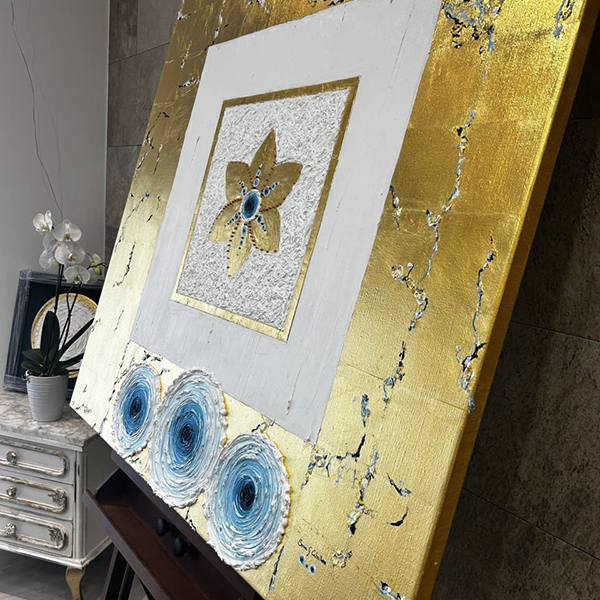
This observation has become one of the conceptual foundations of my own artistic practice. When I employ twenty-four-carat gold, sculptural relief, layered surfaces or carefully organised geometric compositions, these decisions are never purely decorative. Every material, every proportion and every relationship between light and texture forms part of a broader investigation into how visual structure contributes to the experience of the artwork itself.
My intention is not to illustrate scientific theories, nor to claim that art can be reduced to measurable biological processes. Instead, I seek to create works capable of sustaining prolonged contemplation—works whose meaning continues to unfold through repeated encounters, inviting viewers to discover new layers of interpretation as their own perception evolves over time.
From this perspective, neuroaesthetics does not define the artwork, nor does it determine its value. Rather, it offers one possible lens through which we may begin to understand why certain artistic experiences remain vividly present in our memory long after we have left the gallery. Great works of art have always possessed this capacity. Contemporary research simply provides new language through which to continue exploring one of art’s oldest mysteries.


Masaru Emoto and the Symbolic Relationship Between Water and Consciousness
Among the figures who have contributed to contemporary cultural discussions surrounding water, perception and consciousness is the Japanese researcher Masaru Emoto.Through his widely known photographic experiments, Emoto proposed that water crystals appeared to adopt different crystalline structures after exposure to words, music, prayer or emotional intention. His images travelled around the world, capturing the imagination of millions of people and encouraging a renewed reflection on the possible relationship between human consciousness and the natural environment.
At the same time, it is important to acknowledge that Emoto’s experiments have generated considerable debate within the scientific community. Questions concerning reproducibility, experimental controls and methodology have prevented his conclusions from being accepted as established scientific evidence. For this reason, I do not approach his work as scientific proof, but rather as a powerful cultural and philosophical contribution that helped revive a conversation about the symbolic role of water within human civilisation.
Throughout history, water has represented far more than a biological necessity. Across cultures and religions it has symbolised purification, transformation, memory, regeneration and the origin of life itself. Long before contemporary science began investigating the complex behaviour of biological water, artists, philosophers and spiritual traditions had already recognised its extraordinary symbolic power.
Within my own artistic research, this symbolic dimension resonates deeply with broader questions concerning perception, transformation and the relationship between living matter and its environment. Whether approached through philosophy, artistic imagination or scientific investigation, water continues to remind us that life is defined not merely by substance, but by organisation, relationship and continuous transformation.
In this sense, Emoto’s work occupies an important place within the cultural landscape that has inspired many contemporary artists to reconsider the invisible relationships between matter, perception and consciousness. Rather than offering definitive answers, it invites us to ask more profound questions—a role that has always belonged to both art and philosophy.
The Fourth Phase of Water: Gerald Pollack and Biological Organisation
If Masaru Emoto contributed to renewing public interest in the symbolic significance of water, the research conducted by Professor Gerald Pollack at the University of Washington opened an entirely different field of scientific investigation concerning its physical behaviour.
For generations, water was understood to exist in three familiar states: solid, liquid and vapour. Pollack’s research proposed the concept of what he describes as a fourth structural state of water, known as the Exclusion Zone (EZ) Water, a subject that continues to generate scientific discussion.
According to Pollack’s research, the Exclusion Zone represents a proposed form of water organisation with characteristics that differ from ordinary liquid water. This concept has generated scientific discussion and continues to be explored within broader conversations about water structure, biological processes and physical organisation.
Although many aspects of this field continue to be investigated, Pollack’s work has contributed to expanding scientific understanding of water beyond its traditional description as a passive solvent. Instead, current research suggests that water plays important roles in numerous biological processes fundamental to life.
As an artist, I find this perspective particularly compelling—not because it provides direct explanations for artistic experience, but because it reveals that nature itself is organised through levels of complexity and order that often exceed our previous assumptions.
This understanding reinforces one of the central ideas behind Neonaturalism: that artistic creation may draw inspiration from the organising principles of nature without claiming to reproduce or demonstrate scientific phenomena.
Rather than illustrating biology, my work explores visual analogies between natural organisation, geometry, materiality and perception. Art remains independent from science, yet both disciplines share the desire to investigate reality through different forms of knowledge.


Geometry, Gold and the Language of Matter
Every civilisation has recognised certain materials as possessing exceptional symbolic significance. Among them, gold occupies a unique place. From Ancient Egypt and Byzantine mosaics to Japanese folding screens and Renaissance masterpieces, gold has consistently represented permanence, illumination, transcendence and the enduring value of human creation.
Within my own artistic practice, however, gold is never employed simply as a symbol of luxury or prestige. Its presence forms part of a broader investigation into the relationship between light, materiality and perception.
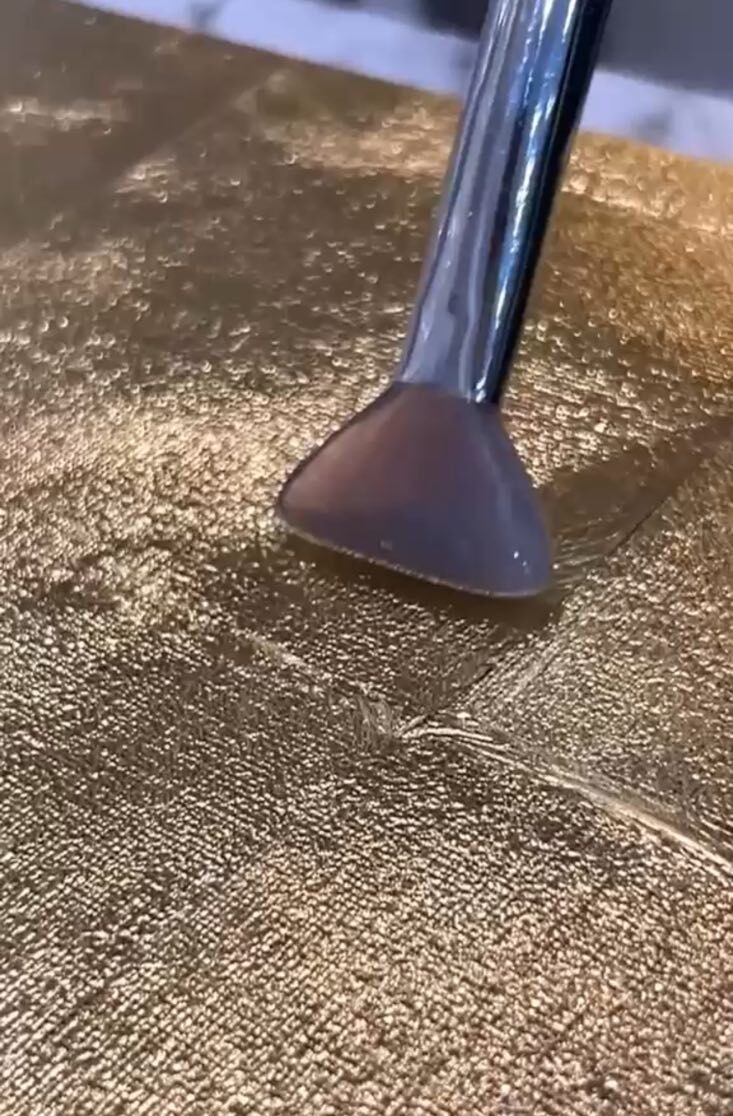
The use of 24-carat gold leaf, together with platinum, mineral pigments, Japanese Urushi lacquer and carefully selected natural materials, allows each artwork to create a unique visual response according to light, distance and the position of the observer. Reflection, absorption and texture become active components of the viewing experience rather than passive decorative elements. Similarly, geometry occupies a central position within my work.
Throughout nature, recurring mathematical relationships appear in flowers, shells, leaves, crystal formations, galaxies and countless biological structures. Among these, the Golden Ratio (Phi) has fascinated artists, architects and mathematicians for centuries because of its remarkable recurrence within both natural growth and artistic composition.
My interest in these geometric principles does not arise from any mystical interpretation, but from their capacity to establish visual balance and structural coherence. Geometry becomes a language through which the artwork organises space, rhythm and movement, inviting the viewer into a slower and more attentive process of observation.
Light, matter and proportion therefore cease to function as isolated aesthetic resources. Together, they become interconnected elements within a broader artistic investigation into beauty, perception and the universal structures that continue to shape both nature and human culture.

Longevity Gene Activation®, Ceramic 18K gold
Neonaturalism: An Artistic Investigation into Perception and Harmony
The central purpose of Neonaturalism is not to propose definitive scientific conclusions, but to expand the possibilities of artistic enquiry. Throughout the history of art, painters have continuously incorporated the knowledge of their own time into their creative practice. Perspective transformed Renaissance painting after developments in mathematics and optics. Impressionism emerged alongside new understandings of light and colour. Likewise, contemporary artistic practice inevitably encounters the intellectual landscape created by neuroscience, biology, artificial intelligence and the sciences of perception.
My own work develops within this context.
Rather than illustrating scientific discoveries, I seek to create artworks capable of generating an experience of prolonged contemplation in which material, light, geometry and symbolism interact as a coherent visual language. Every decision within the composition is carefully considered: the organisation of space, the relationship between relief and surface, the reflective qualities of twenty-four-carat gold, the tactile presence of natural materials and the rhythm established by geometric structures all contribute to the conceptual identity of each piece.
From this perspective, the artwork is no longer understood merely as an image to be observed. It becomes an environment for reflection, encouraging the viewer to slow down, to look more attentively and to establish a deeper relationship with what unfolds before them. Meaning is not delivered immediately; rather, it gradually emerges through sustained observation, memory and personal interpretation.
This understanding lies at the heart of Neonaturalism. Beauty is approached not as ornament, but as a form of knowledge capable of opening new ways of thinking about our relationship with nature, time and human experience.
Art as an Open Dialogue Between Disciplines
One of the defining characteristics of the twenty-first century is the growing dialogue between disciplines that were once considered entirely separate. Artists collaborate with scientists, architects work alongside biologists, designers engage with artificial intelligence, and philosophers increasingly participate in conversations traditionally reserved for technology and medicine.
Art has always occupied a privileged position within these moments of intellectual transformation because it possesses a unique capacity to connect ideas that might otherwise remain isolated from one another.
For this reason, I believe contemporary art should not withdraw from scientific or philosophical debates. Equally, however, it should never become subordinate to them.
Its role is neither to validate hypotheses nor to replace academic research. Instead, art offers something that no other discipline can provide: the possibility of exploring uncertainty through imagination, symbolism and sensory experience.
Within Neonaturalism, scientific concepts become sources of inspiration rather than conclusions. They open conceptual pathways that allow artistic language to investigate questions concerning perception, beauty, materiality and the human relationship with the natural world.
In this sense, art preserves its essential freedom while simultaneously participating in one of the most fascinating intellectual conversations of our time.

The International Recognition of Neonaturalism
Every artistic movement ultimately enters into dialogue not only with history but also with the society in which it emerges. The international recognition that my work has received represents, above all, an increasing interest in artistic practices that combine technical excellence with conceptual research and cultural dialogue.
Receiving the Global Icon of Artistic Innovation & Cultural Fusion award under the institutional patronage of the Government and Royal Family of the United Arab Emirates represented an important milestone within this ongoing journey. More than a personal distinction, the recognition acknowledges a broader vision of contemporary art—one that embraces innovation without abandoning craftsmanship, tradition or cultural memory.
For me, this recognition reinforces the responsibility to continue developing an artistic investigation grounded in intellectual rigour, technical discipline and long-term cultural commitment. It also confirms that contemporary art continues to be valued not only for its visual impact but also for its capacity to contribute meaningfully to wider conversations about society, knowledge and the future.
Rather than marking a conclusion, such recognition represents another stage within an artistic practice that remains open, evolving and committed to continuous exploration.
 Global Icon of Artistic Innovation & Cultural Fusion, Royal Family and Government UAE, in Zabeel Ladies Club
Conclusion: The Algorithm of Universal Beauty
Throughout history, every civilisation has sought to understand why certain forms, proportions and materials possess an enduring ability to move us. The answer has never belonged exclusively to art, science, philosophy or mathematics. Instead, it has emerged from the dialogue between them.
The Algorithm of Universal Beauty is neither a scientific theory nor a fixed doctrine. It is an artistic manifesto that proposes a different way of approaching beauty: not as a superficial aesthetic quality, but as a field of investigation where material, geometry, perception and cultural memory converge. Neonaturalism is the result of that ongoing enquiry.
It invites us to reconsider the artwork not simply as an object of contemplation but as a place where knowledge, imagination and human experience encounter one another. Within this framework, tradition and innovation cease to be opposing concepts. They become complementary forces participating in the same continuous process of cultural evolution.
Ultimately, I believe that the greatest works of art are those that continue asking questions long after the historical moment in which they were created has passed. They remain alive because they continue generating meaning, inviting new interpretations and accompanying each generation through changing intellectual landscapes. This is the purpose that guides my artistic practice.
To create works that establish an enduring dialogue between matter and thought, between memory and the future, between artistic tradition and contemporary knowledge. Because art does not preserve the past by remaining still. It preserves it by continuing to evolve.
The Algorithm of Universal Beauty is, above all, an invitation to continue that conversation.